How to Correctly Complete an NVD (paper copy)
When moving livestock such as sheep, cattle, or goats between Property Identification Codes (PICs) — whether from farm to farm, farm to saleyards, farm to show, or from saleyards to abattoirs or feedlots — an accurately completed National Vendor Declaration (NVD) is required. This legal document ensures traceability and accountability in the livestock industry.
The NVD also facilitates the transfer of livestock information in the National Livestock Identification System (NLIS) database. Regardless of whether you’re moving a single calf or lamb, the animal must have an approved fitted eID device and a NVD must be fully and correctly completed as it is a binding legal declaration.
To order a NVD hard copy book, click on the following link below (you must have a PIC number registered to your property and be LPA accredited - even for 1 acre and carry any number of livestock on your property): https://lpa.nlis.com.au/welcome
Here's what you need to know to complete your NVD correctly and common mistakes to avoid:
Why is the NVD Important?
Traceability: Provides vital information about the origin and movement of livestock.
Food Safety: Ensures accurate records for animal health and biosecurity.
Compliance: Failure to complete the NVD correctly can result in legal penalties.
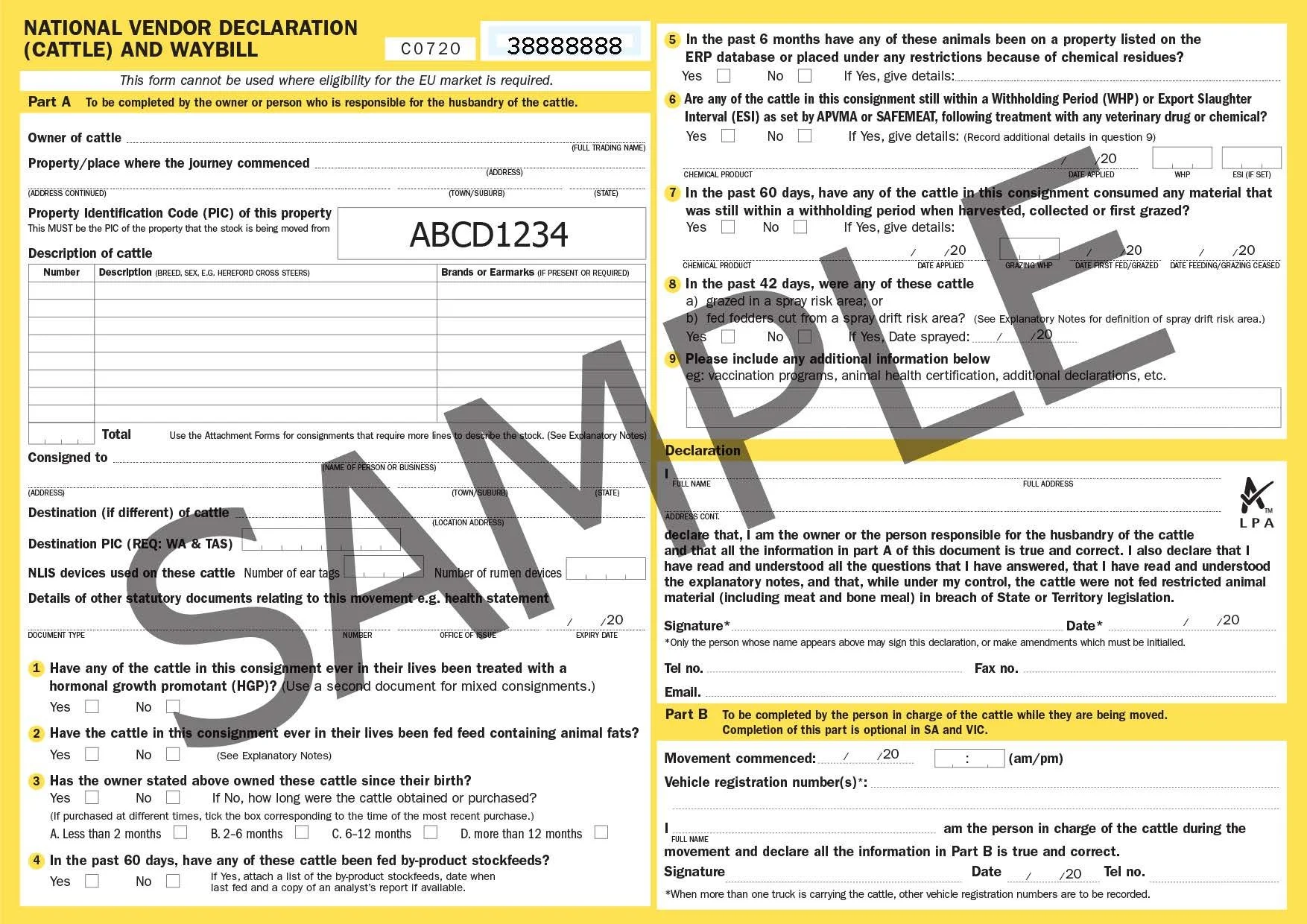
7 Common Mistakes When Completing an NVD:
Incorrect Property Identification Code (PIC): Ensure both the consigning and receiving PICs are accurate. A single wrong digit can cause traceability issues in the NLIS database. The seller of the livestock MUST ALWAYS provide an NVD, Waybill or correct Declaration (pending state regulations).
Omissions in Animal Details: Buyers rely on the NVD to have accurate information about the livestock they purchase. Processors also rely on NVDs being completed accurately to ensure only safe food is provided to consumers. False or misleading answers on NVDs can lead to prosecution and civil action by the buyer.
Failure to Record Movement in NLIS Database: After the physical movement of livestock, update the NLIS database to finalise the transfer. Neglecting this step can lead to traceability gaps. The buyer has 48 hours to transfer the livestock once received to the corresponding PIC number. Login to transfer your livestock here: https://sso.mla.com.au/u/login?state=hKFo2SA4VzhJTEoyT18zUFhIT2dFTHpMc084REhEdURsN1VnMqFur3VuaXZlcnNhbC1sb2dpbqN0aWTZIEtpR3Nyb0Rlc0p4UFp0T1I1SmVuYW02ck1ZU2JuNld0o2NpZNkgd1Q2MmExWmg0SndGT1hWUGNTOUQxd2U1dWowQWVNb2U
Incomplete Declaration Questions: You must complete all questions on the NVD for your NVD to be valid.
Illegible Writing: If you are completing a hard cop NVD, make sure your writing is as clear and neat as possible. You cannot tick both ‘yes’ and ‘no’ in response to the one question.
Using a Sample, photocopied or Outdated NVD Version: You cannot use a sample NVDs or photocopied copies of the NVD. If you are using a paper copy NVD, it must be from a hard copy NVD book for your PIC. Each PIC must use an NVD issued to that PIC and it cannot be used for other PICs. To ensure you are using the correct version click the following link: https://www.integritysystems.com.au/on-farm-assurance/national-vendor-declaration-nvd/nvd-0720-changes/
Failing to Sign and Date the Form: You must sign and date the declaration on the NVD the day of movement.
Steps for Completing Your NVD:
Gather Information: Ensure accurate completion of consignor and consignee details, including PIC numbers, the location of the animals, their husbandry information, feeding records, and any applicable withholding periods.
Complete the Form: When completing the NVD questions, you cannot tick both ‘yes’ and ‘no’ in response to the one question. Every question must be answered and truthfully.
Sign and Date: Ensure the declaration is signed and dated with the exact date of movement.
Retain a Copy: Always retain a copy for evidence.
Update NLIS Database: This process must be done by the buyer within 48 hours of receiving the stock onto the PIC destination.
https://www.youtube.com/watch?v=lSY6YhO7a-0
Final Thoughts:
Accurate completion of the NVD is critical for maintaining trust and compliance within the livestock industry. By avoiding common mistakes and ensuring accuracy in every step, you not only meet your legal obligations but also contribute to the integrity and sustainability of the supply chain.
Submitting incorrect or incomplete NVDs during a Livestock Production Assurance (LPA) audit may result in a Corrective Action Request (CAR), which must be resolved with the auditor to maintain compliance.
Additionally, failing to use an NVD or the correct declaration when transferring livestock from and to properties can lead to significant fines and penalties due to the associated biosecurity risks.
For further guidance, consult the LPA, NLIS website (links below), your local agriculture department, livestock advisor or JAB Argi Solutions.
Remember, every declaration counts, no matter the size of the movement!
Disclaimer:
The information provided in this article is true and correct to the best of my knowledge at the time of publication. It is intended for general guidance and informational purposes only. Readers are encouraged to verify any information and seek independent advice relevant to their individual circumstances, particularly where legal, financial, or regulatory compliance matters are concerned.